
Procurement history
Notice and award events
Methodology
Civant's deterministic forecasting model evaluates procurement history, contract lifecycles, cycle timing, seasonality, buyer cadence, framework expiry, and qualified public signals to estimate a likely tender window and confidence context.
Evidence Model
Structured procurement evidence is normalized into explicit timing, recurrence, structural, corroboration, and data-quality features. Those features produce the forecast. AI does not calculate or override the numeric result.
Notice and award events
Cycle proximity and renewal timing
Month and category alignment
Structural timing evidence
Recurrence reliability
Capped, time-decayed corroboration
 CalculateTiming modelFeatures are weighted into probability, score, and confidence outputs with evidence and coverage constraints.
Estimated publication period
Strength of the timing opportunity
Reliability of the supporting evidence
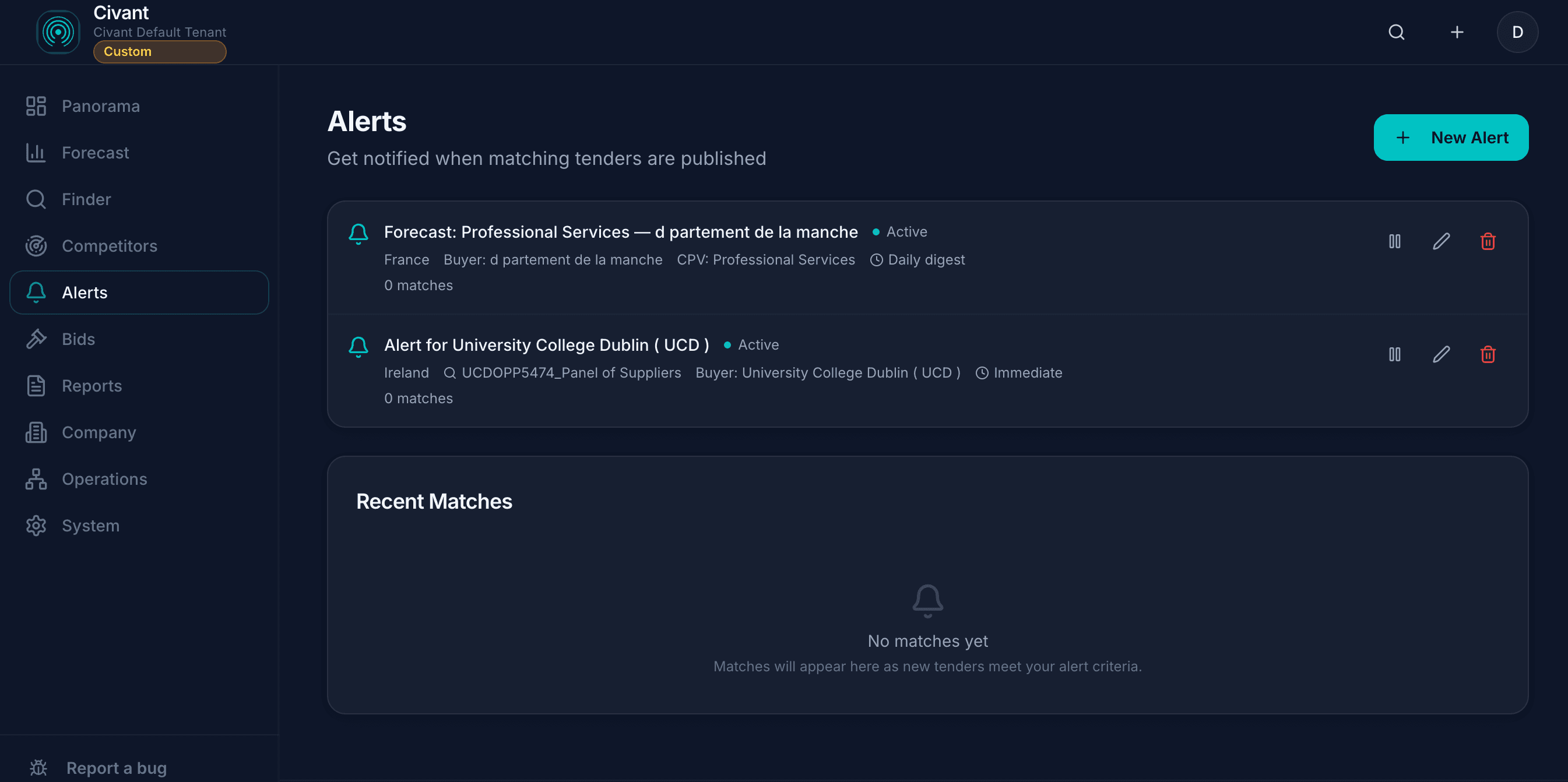
Buyer and competitor intelligence remain first-class platform capabilities. Their roles are explicit so teams can distinguish forecast inputs from account and bid-decision context.
Estimates likely tender timing and returns a forecast score, probability, confidence, and supporting drivers.
Explore forecastingExplains procurement history, recurrence, and account context. Buyer cadence can support direct forecast features.
Explore buyersShows incumbency, wins, participation, and market pressure for positioning and bid decisions. It is not a direct forecast formula input.
Explore competitorsQualified Public Signals
Only normalized, buyer-linked, category-relevant, and evidenced public events can affect scoring. General news and press coverage remain research context unless they pass that process.
Prior information notices, market consultations, and eForms can indicate buyer intent before a formal tender is published when they are linked to the relevant buyer and category.
Verified roles, delivery teams, and specialist hiring can corroborate demand movement around an upcoming programme or service need.
Approved budgets, public funding allocations, and documented grant awards can show that a stated need has financial support behind it.
Evidence-backed policy deadlines, compliance changes, and public programmes can corroborate timing when they are normalized and category-relevant.
Qualified public signals are capped and time-decayed. They cannot replace behavioural procurement evidence, and general news or press coverage remains research context unless it is normalized, linked, and evidenced.
Validation
Civant records forecast evidence and later compares it with published tenders. Resolved cohorts support performance evaluation and probability calibration review. Model changes are deliberate and separately validated, not automatic after each outcome.
The estimated window, score, confidence, drivers, and supporting evidence are stored at computation time.
A subsequently published tender is identified in the public procurement record.
Buyer, category, publication timing, and supporting evidence are compared with the recorded forecast.
Resolved cohorts support performance evaluation and probability calibration review. Model changes remain deliberate and separately validated.
Validation principle: evaluation is based on recorded forecasts and observed outcomes. Model changes require separate review and validation.
Independent review publication standard
Civant will publish independent review outcomes only when the scope, findings, actions, limitations, and implementation status are documented and ready to inspect.
See how PINs, public-sector hiring, budgets, public funding, grant awards, and policy signals can corroborate timing after they are normalized, linked, and evidenced.
Read the resource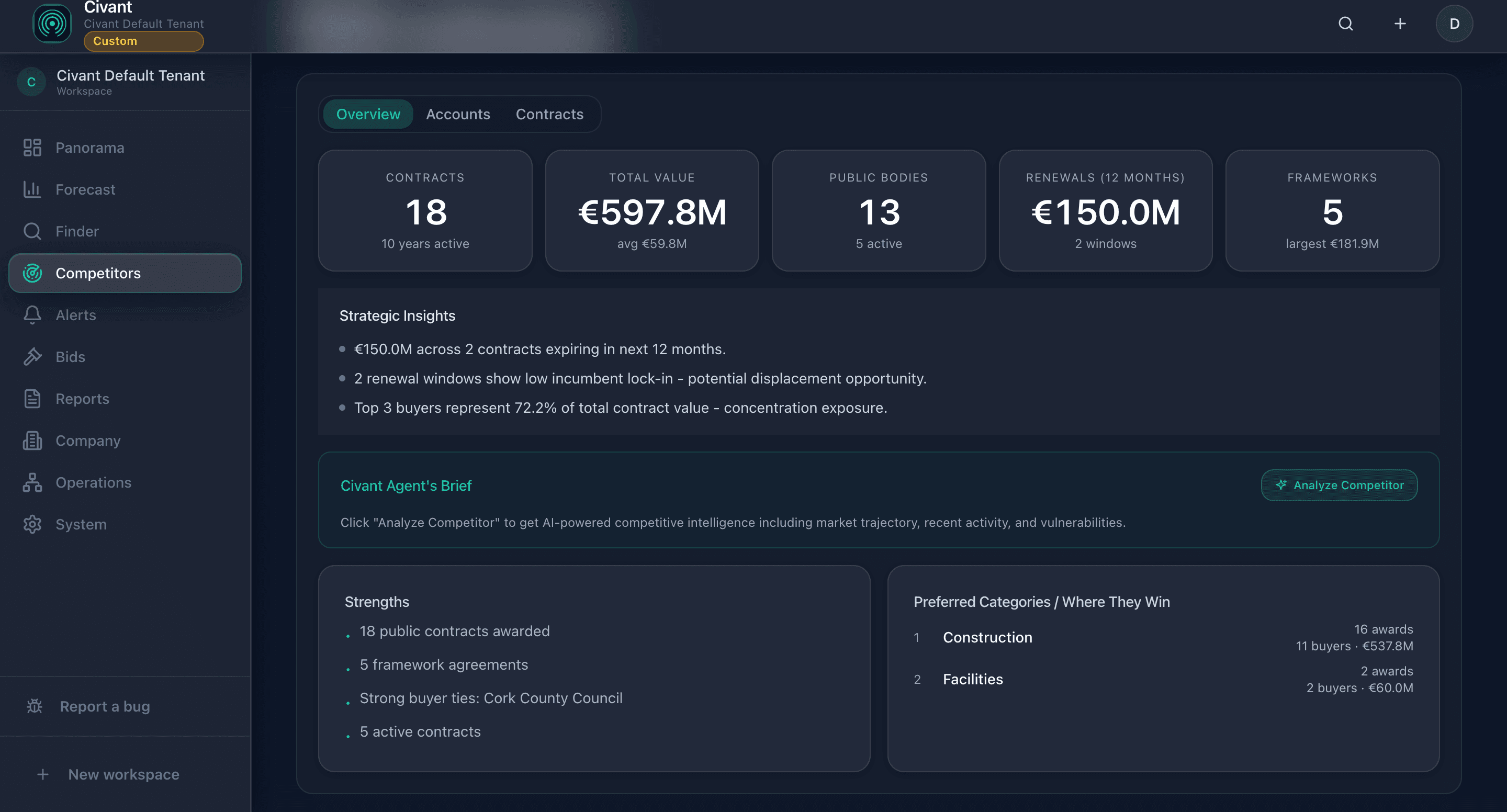
Understand how incumbent position, participation patterns, and market pressure support positioning, account planning, and bid decisions without becoming direct forecast formula inputs.
Read the resourceResponsible Interpretation
Civant helps teams move earlier with evidence and confidence context, without treating forecasts as certainty or replacing commercial judgment.
Civant uses structured procurement records and qualified public signals to support planning before a tender is published.
Forecasts are weighted by evidence quality, corroboration, and observed buyer patterns.
Civant helps teams prioritize where to prepare, engage, and bid while commercial judgment stays with the team.
Civant's deterministic model evaluates procurement history, cycle proximity, seasonality, framework expiry, buyer cadence, and qualified public signals to estimate a likely tender window, forecast score, and confidence context.
The forecast model uses structured procurement notices, award events, contract lifecycle information, buyer and category patterns, PINs and early-market notices, public-sector hiring, approved budgets, public funding and grant awards, and policy or programme signals that have been normalized and linked to a buyer or category.
Civant checks forecast signals against subsequently published tenders. Current platform results evolve as new procurement activity appears. Public performance results are published only when the cohort, method, time window, limitations, and supporting documentation are inspectable.
No. Civant is a procurement intelligence platform with forecasting at its core. AI helps interpret matches, documents, buyer intent, and scope. It does not calculate forecast probability or override the numeric score produced from structured evidence.
No. Civant provides planning and prioritization intelligence, not guarantees about tender publication dates, procurement decisions, or contract award outcomes.
Qualified signals such as PINs, public-sector hiring, approved budgets, public funding and grant awards, and policy or programme movement can provide capped, time-decayed corroboration when they are normalized, linked, and supported by evidence. General news and press coverage remain research context unless they pass that process.
Buyer cadence and procurement history can contribute directly to forecast features. Wider buyer intelligence explains recurrence and account context. Competitor intelligence supports incumbency analysis, positioning, and bid decisions, but it is not a direct input to the forecast formula.
From method to market timing
Use forecast timing, buyer context, competitor intelligence, and the evidence trail together before your team commits bid effort.